
Short answer: the aviation phonetic alphabet is the set of 26 code words pilots and controllers say in place of letters, Alfa for A through Zulu for Z, fixed by the International Civil Aviation Organization and used by every country flying to ICAO standards. The words were chosen so that no two can be mistaken for each other over a noisy radio, which is why J is Juliett with two Ts and why the list has not changed since 1956. Before that, civil aviation spent about ten years running two rival alphabets side by side.
Pilots do not say the letter B. They say Bravo. The reason is not that radios are noisy, or at least that is only half of it. The real reason is that for about ten years after the Second World War, civil aviation was running two different spelling alphabets at the same time, and anyone flying between them was expected to keep both straight.
The chart is below, then the part nobody tells you.
What the aviation phonetic alphabet actually is
It is a spelling alphabet, not a phonetic one. A phonetic alphabet maps sounds to symbols, which is a linguistics tool. A spelling alphabet gives each letter a whole word that is hard to mistake for any other word, so that a letter survives a bad radio, a strong accent and a tired listener. Aviation calls it the ICAO spelling alphabet. Almost everyone else calls it the NATO phonetic alphabet, and both names point at the same twenty six words.
The point is redundancy. B and D and P and V all collapse into the same mush over a radio. Bravo, Delta, Papa and Victor do not collapse into anything.
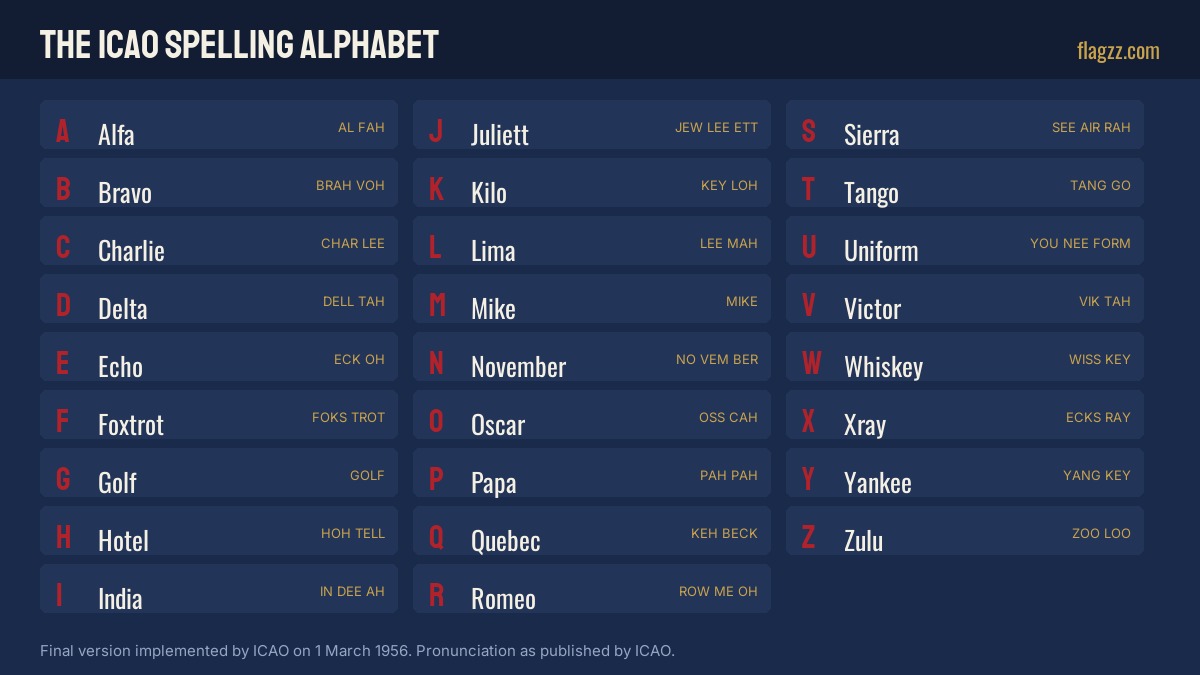
The full A to Z chart
Alfa, Bravo, Charlie, Delta, Echo, Foxtrot, Golf, Hotel, India, Juliett, Kilo, Lima, Mike, November, Oscar, Papa, Quebec, Romeo, Sierra, Tango, Uniform, Victor, Whiskey, Xray, Yankee, Zulu.
Three of those look wrong to most people. They are not. More on that below.
The two alphabet problem, which is the bit everybody skips
After the war, civil aviation carried on using the wartime Able and Baker alphabet. It worked in English speaking airspace. It did not work everywhere. ICAO’s own record of the period puts it plainly: civil aviation began to suffer confusion in South America, where the English words were not fully recognised. So a second alphabet, Ana and Brazil, was introduced for the South American and Caribbean regions.
Read that again. There were now two alphabets, and a pilot who flew both regions had to carry both in their head. ICAO described the result as the possibility of error and confusion for those who flew in both Spanish speaking and other areas. That is the hazard the modern alphabet was built to remove. It was never really about static.
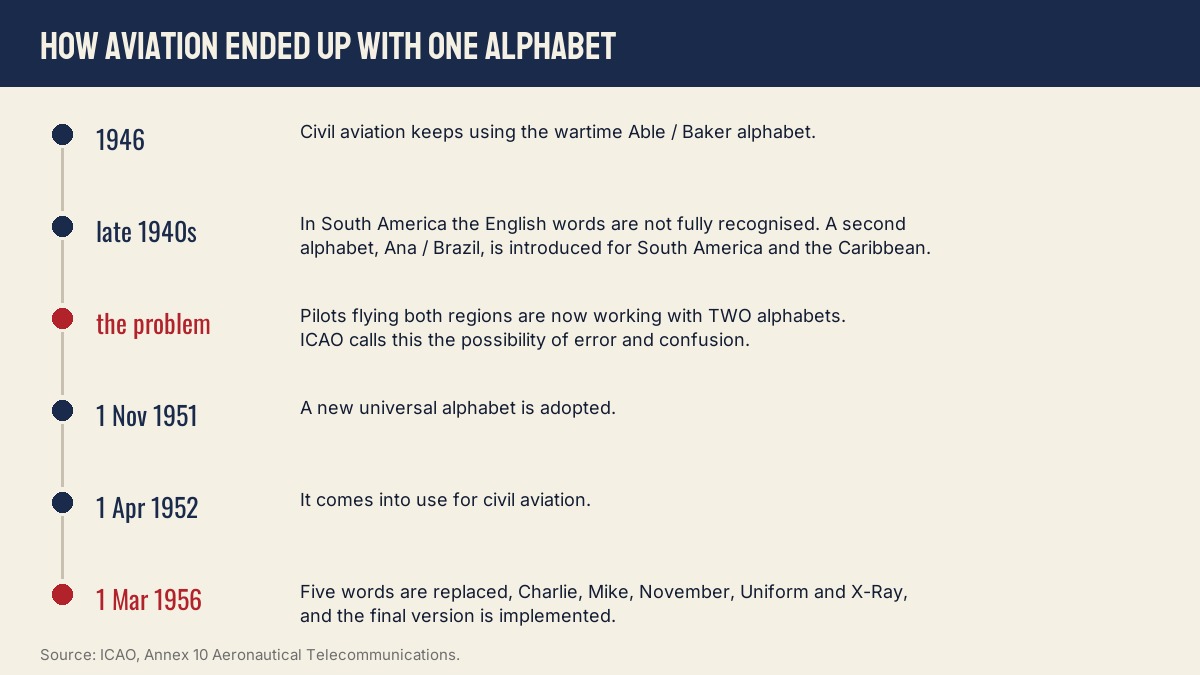
A universal alphabet was adopted on 1 November 1951 and came into use for civil aviation on 1 April 1952. It still was not right. Five words were replaced, Charlie, Mike, November, Uniform and X-Ray, and only then was the final version implemented, on 1 March 1956.
One date worth getting straight, because most pages online do not: 1 March 1956 is the ICAO implementation date. NATO adopted the list on 1 January 1956. Different bodies, different dates, same words.
Why Alfa, Juliett and Xray are spelled that way
These three are the reason this chart stops people. They look like somebody at ICAO could not spell. The opposite is true: they are spelled defensively, for readers whose first language is not English.
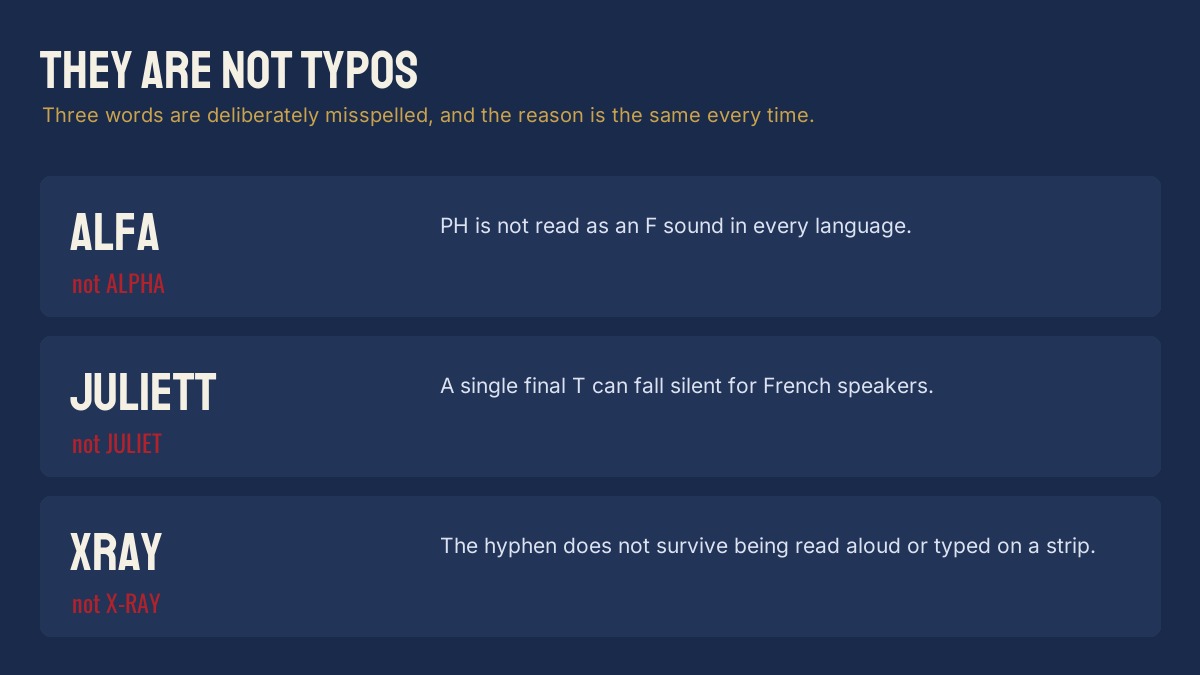
Alfa, not Alpha. The letters PH are not read as an F sound in every language. Spell it with an F and nobody has to guess.
Juliett, not Juliet. A single final T can fall silent for a French speaker. Doubling it keeps the sound.
Xray, not X-Ray. A hyphen does not survive being read aloud, and it does not survive being typed onto a flight progress strip either.
If you ever see a chart printed with Alpha and Juliet, it is a chart somebody retyped from memory rather than from the standard.
Why it is still used when the radios are digital
Because the weak link was never the radio. It is the human ear, at the end of a twelve hour duty, listening to an accent they have not heard before, through a headset, while something else is beeping.
Aircraft registrations are letters. Taxiway identifiers are letters. Runway exits, holding points, parking stands, squawk codes read back letter by letter, the lot. Get one letter wrong on a taxi instruction at a large airport and you are on a runway somebody is about to land on. The alphabet costs nothing and removes a whole class of mistake, which is a very good trade.
Where you hear it outside the cockpit
Almost everywhere, once you start listening. Call your bank and spell your surname and you will reach for it. Police and ambulance crews use it. Shipping uses it. IT support uses it, badly, usually inventing their own words halfway through.
That is the quiet thing about this list. It was written to solve a specific aviation problem in a specific decade, and it turned out to be the best tool anybody has ever built for saying a letter out loud.
Wear the chart
We print the whole alphabet, spelled the way ICAO actually spells it, Alfa and Juliett and Xray included. It is our aviation phonetic alphabet tee on heavyweight garment dyed Comfort Colors cotton. If you want the rest of the line, there is Pilot Evolution and I Collect Takeoffs, and the whole aviation collection sits together. Free US shipping on every order, no minimum.
Questions people actually ask
Why do pilots use the phonetic alphabet? To stop single letters being misheard. Letters that sound alike over a radio, like B and D and P and V, become words that sound nothing alike. It was standardised after two different alphabets ended up in use at once, which was the real hazard.
Is it the NATO alphabet or the ICAO alphabet? The same twenty six words. NATO adopted the list on 1 January 1956 and ICAO implemented the final version on 1 March 1956.
Why is Alfa spelled with an F? Because PH is not pronounced as an F in every language, and the alphabet has to work for people who are not reading it in English.
Why does Juliett have two Ts? So that the final T is still sounded by speakers, French speakers in particular, who would let a single final T go silent.
Did the whole alphabet change in 1956? No. Five words were replaced, Charlie, Mike, November, Uniform and X-Ray. The rest had already been in use since 1952.
Sources
Dates, the five replaced words and the Able and Baker to Ana and Brazil history are taken from ICAO’s own record of Annex 10, Aeronautical Telecommunications. The NATO adoption date of 1 January 1956 is from NATO’s own record of the alphabet, which cites declassified document SGM-0217-55 from the NATO Archives (The NATO phonetic alphabet). The 26 code words in operational use today, and their official pronunciations, are set out by the FAA in the Aeronautical Information Manual, chapter 4 section 2.