
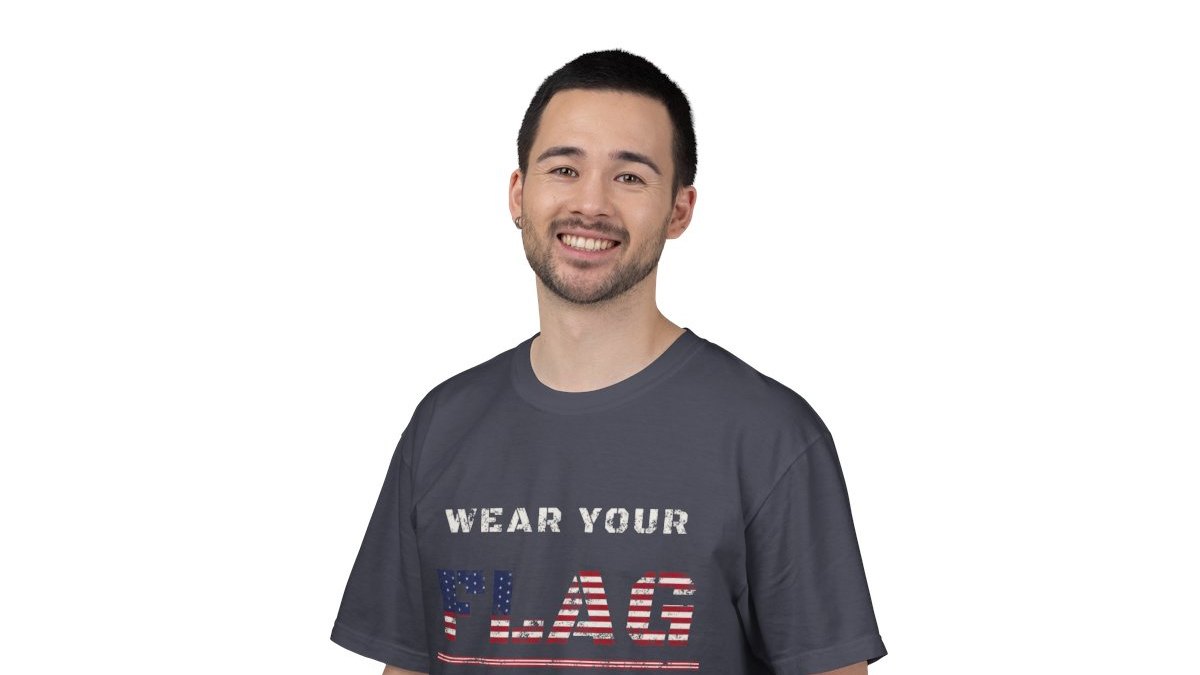
Short answer: the United States Flag Code says the flag “should never be used as wearing apparel,” but that line is guidance, not an enforceable law. The Supreme Court has protected flag expression as free speech since 1989, so no one can be fined or arrested for wearing an American flag shirt.
It is one of the most searched questions about the flag, and the honest answer has two halves that seem to contradict each other. There is a written rule that says do not do it. There is also settled constitutional law that says the government cannot punish you for doing it. Both are true, and understanding why is what tells you how to wear the flag well.
What the US Flag Code actually says
The relevant passage is 4 U.S. Code § 8, titled “Respect for flag.” Three subsections matter for clothing:
- § 8(d): “The flag should never be used as wearing apparel, bedding, or drapery.”
- § 8(i): “The flag should never be used for advertising purposes in any manner whatsoever.”
- § 8(j): “No part of the flag should ever be used as a costume or athletic uniform. However, a flag patch may be affixed to the uniform of military personnel, firemen, policemen, and members of patriotic organizations.”
Read those carefully and you will notice the word running through all of them is should, not must. The Flag Code contains no penalty, no fine and no enforcement mechanism. It was written in 1942 as a statement of custom, a way of setting down what respectful handling looks like, and it has stayed that way ever since.
There is also a distinction the Code itself draws that most people miss. Section 8(d) is about using the flag, an actual flag, as clothing. Draping a real flag around yourself as a cape is the thing it was written about. A shirt with a flag design printed on it is a representation of the flag, not the flag itself, which is why § 8(j) can turn around and expressly permit flag patches on uniforms.
So why does everyone wear it anyway?
Because the First Amendment settled the question. In Texas v. Johnson, 491 U.S. 397 (1989), the Supreme Court struck down a Texas flag desecration law by a 5 to 4 vote, holding that flag burning in protest is expressive conduct protected by the First Amendment. The Court wrote that government “may not prohibit the expression of an idea simply because society finds the idea itself offensive or disagreeable.”
If the Constitution protects burning the flag in protest, it comfortably protects wearing one on a t-shirt. That is the legal end of it. Any rule restricting flag apparel would have to survive First Amendment scrutiny, and a rule based purely on taste would not.
So the Flag Code survives as what it always was: a code of manners. Manners still matter, which is the part worth taking seriously.
The one place it can still matter: wearing a flag shirt to vote
This is the question almost nobody covers, and it is the one that can actually cause you a problem at a door.
Many states restrict “political” apparel inside a polling place, on the theory that a voter should not be campaigned at while casting a ballot. In Minnesota Voters Alliance v. Mansky, decided 14 June 2018 by 7 votes to 2, the Supreme Court struck down Minnesota’s version of that ban. Chief Justice Roberts wrote for the Court that the law was too vague to stand, because a voter could not reasonably work out in advance what counted as political.
What Mansky did not do is abolish polling place dress rules altogether. The Court treated the polling place as a space where a state may impose reasonable, clearly defined restrictions. Several states rewrote their rules afterwards rather than dropping them.
In practice, a plain American flag shirt with no candidate, party, slogan or campaign message on it is not political apparel, and is very rarely an issue. The risk sits with anything that pairs the flag with a political message. If you are voting and you are unsure, the safe move is to check your own state’s election office guidance before you go, or simply wear the flag shirt on a different day.
Why the flag looks backwards on uniforms
If you have ever looked at a soldier’s right shoulder and thought the flag was on the wrong way round, it was not a mistake. Under Army Regulation 670-1, the flag patch is worn with the star field, the canton, facing forward.
The reason is that a flag carried into battle streams behind the person carrying it. With the stars leading, the patch reads as a flag advancing. Worn the conventional way on the right shoulder, the stars would trail the stripes, and the image would be one of retreat. So the “backwards” flag is not reversed at all. It is a flag moving forward.
Which arm does the flag patch go on?
The reversed patch is worn on the right shoulder. That is where the forward-facing rule applies. This is one of the few places the Flag Code explicitly blesses the flag on clothing, under § 8(j), for military personnel, firefighters, police and members of patriotic organisations.
How to wear the flag well
None of this is enforceable, so treat it as what it is: the difference between wearing the flag thoughtfully and wearing it carelessly.
- Wear a design, not a flag. An actual flag is meant to be flown, folded and retired properly. A shirt is a shirt.
- Keep it upright and whole. An inverted flag is a recognised distress signal, not a style choice. Use it that way only if you mean it.
- Look after it. A faded, respectfully worn shirt is fine. One that is filthy or falling apart is a different message.
- Read the room. A parade, a ball game and a funeral are not the same occasion.
- Skip it at the polls if a message is on it. Covered above.
Our Flag Classics designs are drawn with this in mind: the flag rendered as artwork rather than reproduced as a literal flag, which is both better manners and a better shirt. The same thinking runs through our Veterans and Military range, where we deliberately use no official branch insignia, because those marks belong to the services that earned them.
Veterans Day, Memorial Day and the Fourth
There is no rule anywhere that restricts flag clothing to particular dates, and no rule against wearing it on any of them. The American Legion, which has advocated on flag etiquette for over a century, treats the question as one of respect rather than of calendar.
The distinction people usually want is about tone. Memorial Day honours those who died in service, so it carries a weight the Fourth of July does not. Veterans Day honours everyone who served, and is the one day of the three where a veteran is most likely to be thanked by a stranger. Dress for the occasion rather than for the date.
If you want the story behind two of the phrases you will see most often on flag apparel, we have written about what 1776 on a shirt actually means and about the origin of Home of the Free Because of the Brave.
Frequently asked questions
Is it legal to wear the American flag on clothing?
Yes. The Flag Code discourages it but carries no penalty, and since Texas v. Johnson in 1989 the Supreme Court has treated flag expression as protected speech. No one can be fined or arrested for wearing an American flag shirt.
Is it disrespectful to wear an American flag shirt?
Most people do not think so, and tens of millions are worn every year. The distinction that matters is between a printed design, which is a representation of the flag, and an actual flag worn as a garment, which is what the Flag Code was written about.
What does the Flag Code say about clothing?
Section 8(d) says the flag should never be used as wearing apparel, bedding or drapery. Section 8(j) says no part of the flag should be used as a costume or athletic uniform, but expressly allows a flag patch on the uniforms of military personnel, firefighters, police and members of patriotic organisations.
Can you wear an American flag shirt to vote?
Usually yes. Some states restrict political apparel inside polling places, and the Supreme Court confirmed in Minnesota Voters Alliance v. Mansky (2018) that such rules must be clearly defined. A plain flag shirt with no candidate, party or campaign message is rarely treated as political, but check your state election office if yours carries a slogan.
Why is the American flag backwards on military uniforms?
So it reads as advancing. Army Regulation 670-1 requires the star field to face forward on the right shoulder, which mimics a flag streaming behind its bearer as they move ahead. Worn the other way, the stars would trail the stripes and suggest retreat.
This article explains general flag etiquette and publicly available law. It is not legal advice. Polling place rules in particular vary by state, so check your own state election office if you are unsure.